Home / No-show fees
No-show fees, charged for you
Empty chairs, twelve months
$1,920
$40 × 4 a month × 12, or $160 a month. Your figures, our multiplication.
Set a deposit and a cancellation window. When a client no-shows or cancels late, you tap once and Sessurely charges the fee through Stripe. No invoice to chase, no confrontation, and nothing charged behind your back.
Want late cancels and your own deposit rules in it? Open the full calculator.
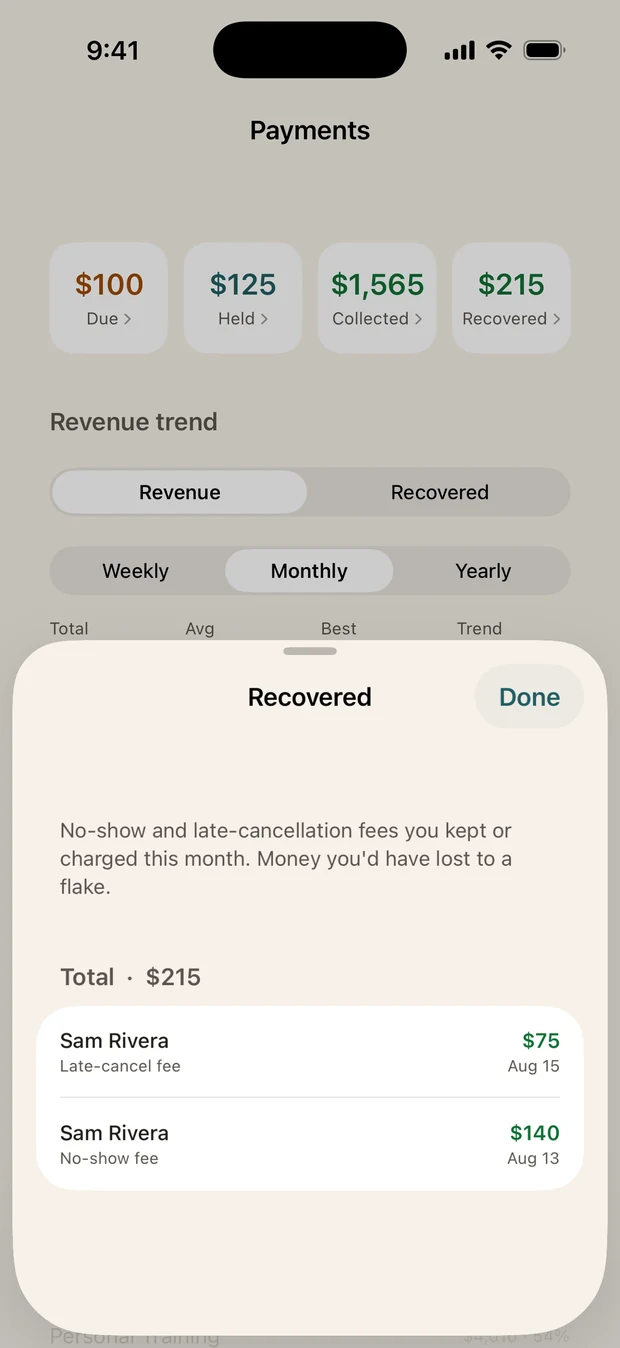
Recovered, in the shipped app. Demonstration data.
The message you never have to send
Nobody has ever enjoyed asking a client for money in exchange for nothing.
Which is why almost every no-show fee that exists on paper is never actually charged.
How it works
Set it up once. It runs every day after.
Three things happen. Two of them run without you, and the third takes one tap.
Build your booking page
Add your services, choose which ones need a deposit, and set your cancellation window. Already have a client list? Import your contacts from iPhone, Android or CSV and start booking people you know on day one.
Clients book and add a card
They pick a time, see the deposit and the policy up front, and add a card, stored securely by Stripe, never by us. Afterwards a private link lets them confirm, reschedule or cancel within your policy, add the session to their calendar, and leave a review once it is done.
You decide, Sessurely collects
Reminders go out on their own. If someone does not turn up, you mark the no-show and the fee you set is charged to the card they already agreed to. Follow-ups are drafted for you to approve. You are asked before any money moves, every time.
It is a button, and pressing it is not the brave part. The awkward conversation already happened at booking, when the client read the policy and agreed to it in writing. The other options are a tool that charges without asking you, or an invoice you have to send yourself. One takes the judgement away, the other gives you the whole job. This asks you once, and then does the work.
A $40 no-show fee, line by line
Every row here appears in your own Stripe dashboard. Ours is the smallest number on it.
| Your client is charged | $40.00 |
|---|---|
| Stripe, 2.9% plus 30 cents | −$1.46 |
| Sessurely, 2% capped at $10 | −$0.80 |
| Lands in your balance | $37.74 |
Nothing is added to what your client pays. The figure on their statement is the fee you set, and our 2% comes off your side as a Stripe application fee on an account in your name. There is no point in the journey where the money is ours. Sessurely never holds your money.
Our refund terms are in section 6 of the Terms.
Never the same word twice
A saved card is not a payment. You should never have to wonder which one you have.
This is where most tools get sloppy, and it is expensive. Three different facts about your money, so three different words, three different shapes, and the amount spelled out every time.
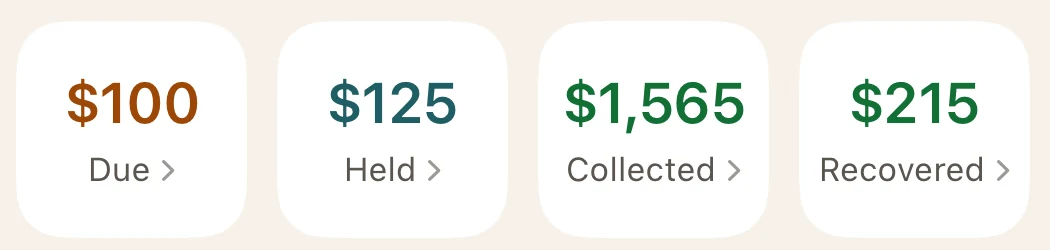
- Due $100
- Owed to you. Nothing has arrived.
- Held $125
- Deposits already paid, sitting in your Stripe balance, set aside for a session that has not happened.
- Collected $1,565
- Money earned and yours, including cash you recorded by hand.
- Recovered $215
- Fees kept from sessions nobody attended. Green, because it is money kept.
Deposit paid
$25 taken · counts toward the $65
Money already in your Stripe account, set aside for that session. It comes off the client's balance on the day.
Card held
$0 taken · $65 on the card
Nothing charged. The card is saved and only used if they miss the appointment or cancel inside your window.
Nothing held
$0 · nothing to charge
If they don't arrive, the hour is simply gone. This is the state every other scheduler leaves you in.
Different words, different borders, and the amount on every row. Your accent colour is yours to choose, which is exactly why colour never carries the meaning on its own. A client who has not paid and might not turn up is flagged before the day, not explained afterwards.
Why deposits and no-show fees work
When a client has money on the line, they show up. Scheduling providers and industry studies consistently report that paid or deposit-backed appointments no-show far less often than free ones.
The bars below show direction, not measured rates. Reliable no-show figures for solo practitioners are not published anywhere, which is why Sessurely shows you your own.
Automated reminders add to that. In the largest randomised trial of appointment reminders, covering more than 158,000 visits, a second reminder cut missed appointments by a further 7% to 11%. But the mechanism is not really the money. It is that a booking with a card attached feels like an appointment rather than an intention. A client who has agreed to a policy has thought, once, about what happens if they do not turn up, and that thought is what gets them to text you at 6am instead of going quiet.
Which is why a policy is worth setting even in a month you never enforce it. What it settles for certain is who carries the cost: when a client does not turn up, that hour is paid for by them and not by you.
A single recovered no-show usually covers Sessurely for the month. See what no-shows cost you.
You're in control
Set the policy that fits your business
Nothing here is a platform default you have to live with. Every rule is yours, per service.
Per-service deposits
Require a deposit on the services that need protecting, and keep others free. A first consultation and a four-hour session do not need the same rule.
Your cancellation window
Choose how much notice counts as on time: 12 hours, 24, 48. Inside it, a late cancel is charged the no-show fee, because to your calendar the two are the same thing.
A clear, upfront policy
Clients see the deposit and the policy before they pay, and agree to it on the spot. That is their fairness signal and your cover if a charge is ever disputed.
Deadlines are shown as real dates and times, not as "48 hours", which is a sum the client has to do at the moment they are least inclined to. A free policy template is there if you would rather start from wording that works.
More than no-show protection
No-show fees are what you came for, and they sit inside a full booking app: your own booking page, a calendar that stays in sync, and a real client book with history, notes and photos. Add your services and deposits, send intake forms, sell gift cards and packages. Reminders go out on their own, and follow-ups are drafted for you to approve.
You keep what you earn, too. There is no commission on your sessions. Money goes straight to your own Stripe account, and your clients are always yours.
Pricing
Free for everyone, with no clock on it.
Starter does not expire and never asks for a card. We would rather be paid when appointment protection actually produces money than charge you for a calendar.
So when it produces money, we take 2% of a deposit or a no-show fee, capped at $10.
Nothing on your session prices. Nothing on packages or gift cards. Nothing added to what your client pays.
Starter
Free for everyone
Start on StarterNo card. No trial clock. It does not expire. Your booking page, client book, calendar, intake forms, a waitlist, email reminders and 100 texts a month to U.S. numbers.
Pro
Free for 7 days$69.99/mo
Get paid with ProOr $599.99 a year, an effective $49.99 a month. Deposits, no-show and late-cancel fees, card on file, packages, gift cards, and unlimited texts to U.S. numbers. Follow-ups are drafted for you to approve, never sent on your behalf.
FAQ
No-show fees: common questions
How does no-show charging work?
The client adds a card and agrees to your policy when they book. If they do not turn up, you mark the no-show and the fee you set is charged to that card through Stripe. No invoice and no chasing. Nothing is ever charged without you confirming it, which is the part most tools get wrong.
Is it legal to charge a no-show fee?
Charging a no-show or late-cancellation fee is common practice when the client agrees to a clear policy up front, which Sessurely shows at booking. Rules can vary by location and industry, so check what applies to you. This isn't legal advice.
What no-show fee should I charge?
Most independent pros set the fee at a deposit-sized portion of the service price, often 25% to 100%. You choose the amount and the cancellation window per service.
What is the difference between a deposit and a card on file?
A deposit takes money now and counts toward the price of the session. A card on file takes nothing: it is saved, and only charged if the client no-shows or cancels late. They are different promises to a client, so Sessurely never makes them look alike. You choose which one applies, service by service.
Does the client pay a booking fee?
No. Nothing is ever added to the client's total. Our 2% fee, capped at $10, comes off your side and applies only to deposits and no-show or late-cancel fees. Packages and gift cards are 0%, and there is no commission on your session prices.
What if a client disputes the charge?
It happens, and we cannot decide it for you. The client's bank does. What we can do is make sure you are not arguing from memory. The policy the client saw, the fact they agreed to it, when they agreed, what the appointment was and what was charged are all recorded against the booking. That record is why showing your cancellation terms before payment matters more than the wording of them. Our refund terms are in section 6 of the Terms.
Do you take a cut of my clients?
No. Your clients are yours. We are not a marketplace. We never market to them, never list them anywhere and never show them another practitioner. There is no directory, no discovery feed and no competing booking page. Export your client list whenever you like and take it with you if you ever go.
Do my clients need an app or an account?
No. They book from a simple link, with no app to download and no account to create. They pick a time, add a card if you require one, and they are booked. Everything afterwards happens from private links in their email or texts: confirming, filling in an intake form, or moving the appointment themselves. There is never a password to reset.
Is this just a no-show app?
No. It is a full booking app: your booking page, a synced calendar, a real client book, services and deposits, intake forms, gift cards, payments, reminders and follow-ups. No-show protection is the standout feature and the part that pays for itself fastest. It is one piece of a bigger tool.
Do I have to switch off my current scheduler?
Not on day one. Plenty of people run Sessurely alongside what they already use, put their deposit-worthy services in first, and move the rest across when they trust it. Starter is free with no trial clock, so nothing about that decision happens under a countdown. Your old booking link can keep working until you are ready to retire it.
More on no-show protection
Get started
That $1,920 is still sitting in your calendar.
Turn on deposits and no-show fees in minutes. Start free on Starter with no card and no trial clock. Pro is $69.99/mo, or $599.99/yr for an effective $49.99/mo, and free for your first 7 days.