Home / How to stop no-shows
Guide
How to stop client no-shows: 7 strategies that work
A no-show costs more than the appointment. It is an empty hour you cannot get back and income you never collected. Seven strategies that actually move the needle, but start with what the problem is worth fixing.
Free to start · charges run on Stripe · your clients are always yours
Your own numbers
On your numbers, empty chairs cost you about
$270
a month, $3,240 a year
An estimate from the two numbers you just set. Not a measurement, and not a promise about what you'd recover.
Starter won't change that number. Pro is what changes it. A deposit or a saved card means the next one costs the client, not you.
Try Pro free for 7 daysCard required, cancel anytimeWant late cancels and your own deposit rules in it? Open the full calculator.
In this guide
Strategy oneRequire a deposit or prepayment
This is the highest-impact change you can make. When clients have money on the line, they show up. Free appointments are missed far more often than deposit-backed or prepaid ones. You do not have to charge the full price, even a modest deposit creates commitment.
Two details matter more than the amount. Take it per service, so a first consultation and a four-hour session are not governed by the same rule. And say what it counts toward: a deposit that comes off the price of the session reads as a payment, while an unexplained one reads as a fee.
Strategy twoKeep a card on file and charge no-shows
A policy with no teeth gets ignored. Storing a card at booking, securely, via a processor like Stripe, lets you actually charge a late cancel or a no-show, without an awkward invoice. See how no-show fees get charged →
A card on file is a different promise from a deposit, and it is worth being precise about which you are making. A deposit takes money now. A card on file takes nothing: it is saved, and only charged if the client does not turn up. Clients accept the second one more readily, because the honest sentence for it is nothing is charged unless you no-show, and for most people that is a condition they never expect to meet.
Strategy threeSend automated reminders
Reminders are the single most effective free lever. In the largest randomised trial of appointment reminders, covering more than 158,000 visits, adding a second reminder cut missed appointments by a further 7% to 11%. Send a confirmation immediately at booking, then a reminder 48 and/or 24 hours before, with the date, the time and anything they need to bring or prepare.
Put the reschedule link in the reminder itself. A reminder that only tells someone they are late-notice trapped is a reminder they ignore; one that offers them a way out converts a no-show into a moved appointment.
Strategy fourSet a clear, written cancellation policy
Tell clients exactly what counts as on time, and what a late cancel or a no-show costs, before they book. Frame it around mutual respect for each other's time. Grab a free cancellation policy template →
Write the deadline as a date and a time, not as a duration. “Free to cancel until Sunday at 2:30pm” is a fact; “48 hours notice” is a sum, and the client does it at the moment they are least inclined to. This is also your cover if a charge is ever disputed, so it needs to be visible before payment rather than linked underneath it.
Strategy fiveMake rescheduling self-serve
The harder it is to reschedule, the more likely a client just skips. A self-service reschedule link turns a would-be no-show into a kept, later, appointment with zero effort from you. Sessurely gives every client a private link to reschedule in one tap: no login, no back-and-forth.
It should also show what cancelling would cost, computed against your window, before the cancel button. A client who can see that moving is free and cancelling is not will usually move.
Strategy sixConfirm the appointment
A one-tap confirm a day or two out surfaces the clients who have quietly checked out, so you can fill or follow up before the slot is wasted. In Sessurely that same link lets them confirm, add the session to their calendar and get directions, so it stays top of mind.
Treat an unanswered confirmation as information rather than a failure. Combined with a client's own history it is the earliest honest signal you get, and it arrives while you can still do something about it.
Strategy sevenRun a waitlist
Even with everything above, some cancellations happen. A waitlist lets you offer a freed-up slot to someone else automatically, so a cancel does not have to mean an empty hour. It is also the only one of the seven that turns a cancellation into revenue rather than merely protecting you from losing it.
Sessurely does all seven for you. Deposits, card on file, no-show fees, reminders, policies, self-serve rescheduling, confirmations and a waitlist, in one tool built for independent pros. Start free →
The eighth thing
Knowing which appointment is about to go wrong
The seven above are policy. This is the part a person cannot do by hand: reading a client's own history, how often they have arrived, how late they have cancelled, whether they have confirmed this one, and flagging the session that is likely to be missed while there is still time to act.
It shows on the day's screen as a plain sentence, with the fix beside it: send a card request, send a reminder, or offer the slot to the waitlist. It is never shown to your client, and it is never a label you have to interpret.
A prediction is only useful if it arrives before the appointment. Anything that tells you afterwards is a report, not a warning.
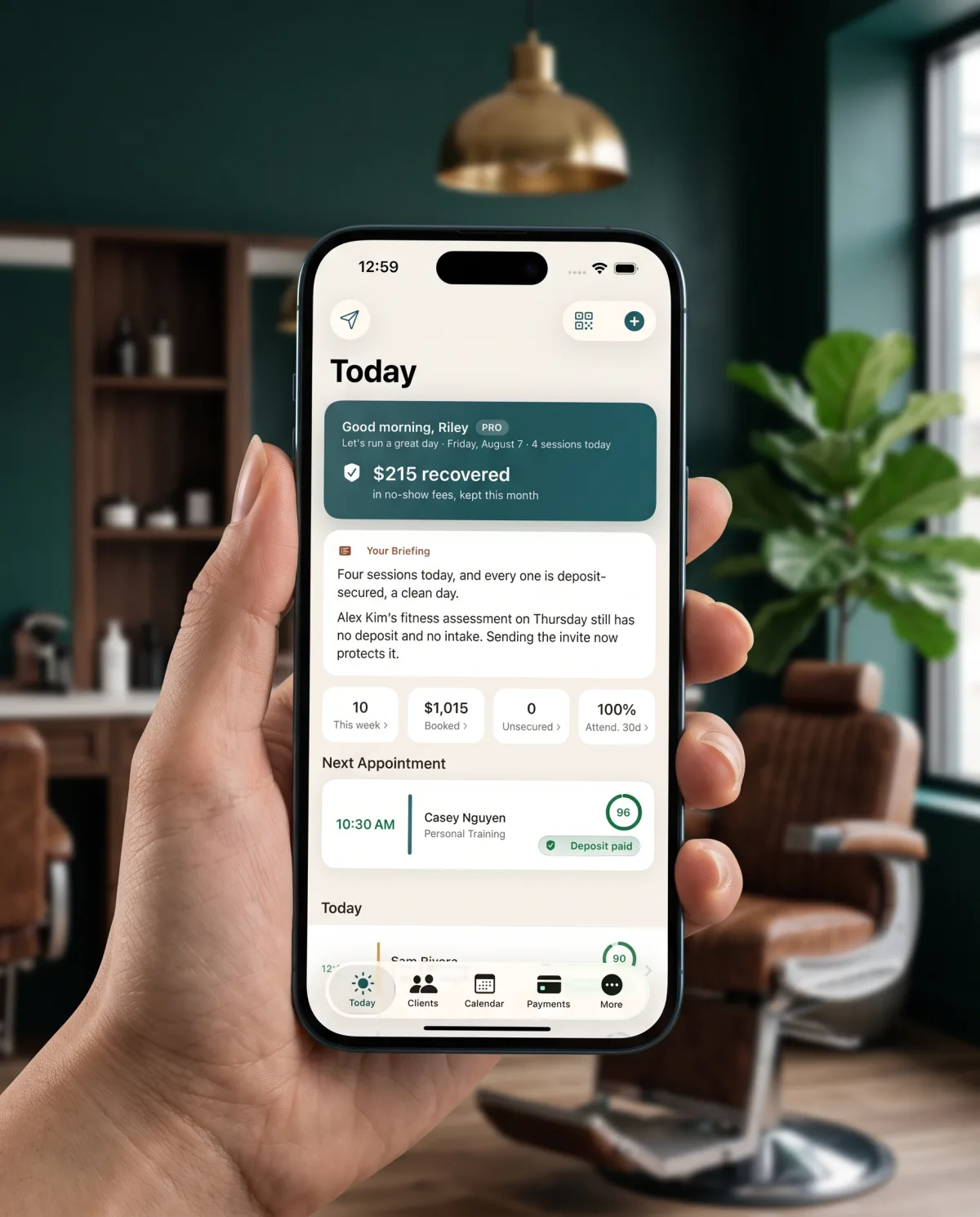
What you see the day before
One no-show in the last 90 days, and this one is not confirmed yet.
Confirmed. If they miss it, your policy is already agreed.
Same two clients, two different exposures, and the difference is legible without doing arithmetic.
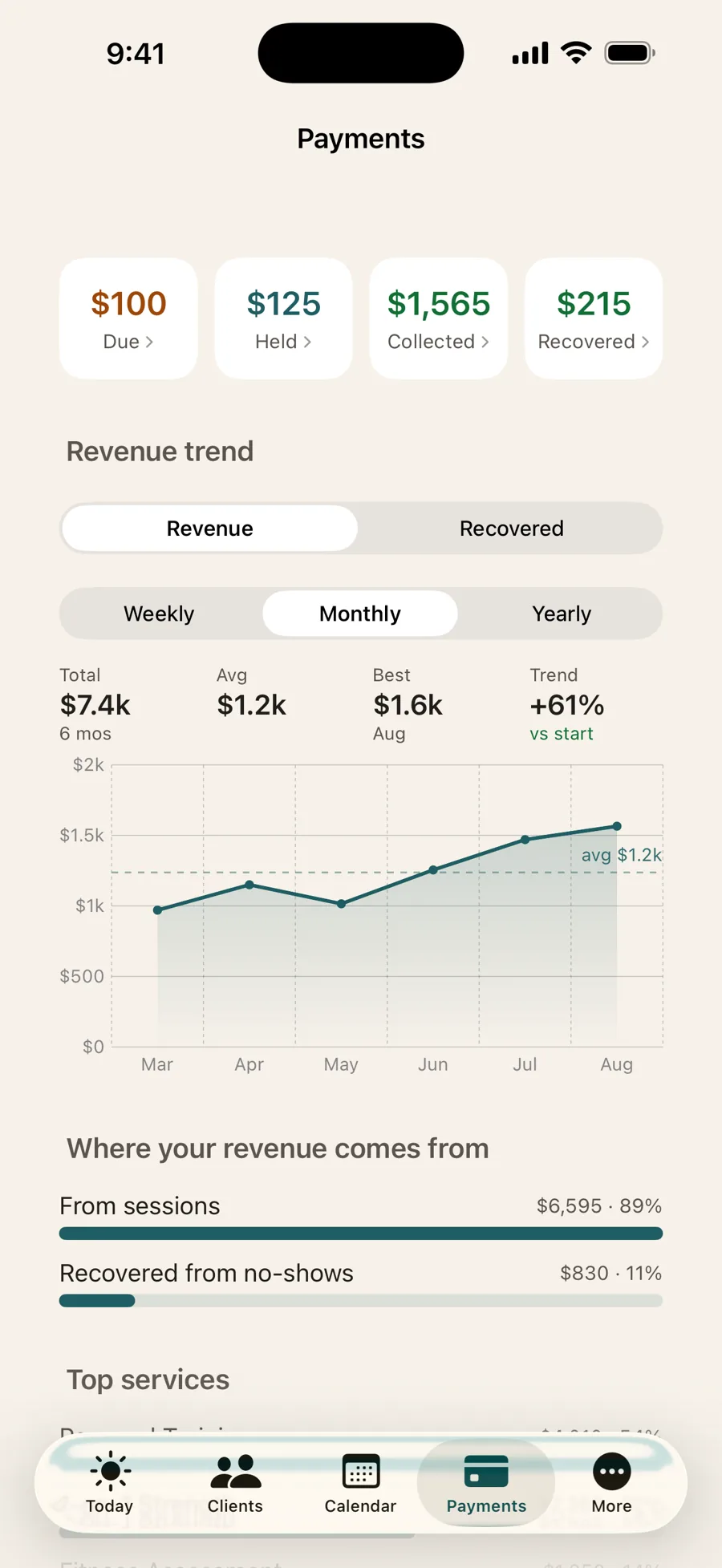
What it looks like when it works
The fee arrives, and you can see that it did.
Due, held, collected and recovered stay apart on purpose, because held is a card saved with nothing taken, and collected is money in your account. A fee you cannot verify is a fee you will end up chasing anyway.
$100
Owed to you
$125
On cards, nothing taken
$1,565
In your Stripe account
$830
From appointments nobody attended
Demonstration figures from the screen beside this one. We have not been running long enough to show you a real host’s numbers, and we would rather say so.
FAQ
No-shows: common questions
What is a normal no-show rate?
Honestly, nobody knows. The figures you see quoted around the web trace back to no primary source, and the platforms that do publish their own data report much lower numbers than the blogs do. What is consistent is the direction: unsecured bookings are missed far more often than deposit-backed ones. Rather than quote an average at you, Sessurely measures your own rate from your own book.
What's the single most effective way to reduce no-shows?
Taking a deposit or keeping a card on file. It creates a real commitment. Pair it with automated reminders and a clear policy for the biggest drop.
Will asking for a deposit put clients off?
For most independent pros it does the opposite. Deposits are normal now, and a clear policy reads as a sign you run a real business. The clients who leave over a deposit are usually the ones who were least likely to turn up.
How much notice should my cancellation window require?
Long enough that you could realistically fill the slot. For a 30-minute appointment 12 to 24 hours is common; for a half-day session 48 hours or more is reasonable. Sessurely lets you set the window per service rather than once for everything.
Two plans
Starter runs your schedule. Pro gets you paid.
Starter is not a demo with the useful parts removed. It runs a real practice, free, for as long as you like. Pro is the money side.
Starter
Free
No card. No trial clock. It does not expire.
- Your own branded booking page and client book
- A calendar that stays in sync
- Email reminders, plus 100 texts a month to U.S. numbers
- Intake forms and a waitlist
Pro
$69.99/mo
or $599.99/yr, effective $49.99/mo
Free for 7 days, card required
- Everything in Starter, plus:
- Deposits, and no-show and late-cancel fees
- Card on file, packages and gift cards
- Session Scores and At-Risk Radar
- Follow-ups and win-back, drafted for you to approve
- Your morning briefing, full analytics, and unlimited texts to U.S. numbers
The only cut we take is 2%, capped at $10, on deposits and no-show/late-cancel fees only. Packages and gift cards are 0%, and there is never a commission on your session prices. For most pros, two recovered no-shows a month more than cover it.
The rest of it
More than no-show protection
No-show fees are what you came for, and they sit inside a full booking app. Sessurely is the booking app that runs your whole appointment business: your own booking page, a calendar that stays in sync, and a real client book with history, notes and photos. Add your services and deposits, send intake forms, sell gift cards and packages. Reminders go out on their own, and follow-ups are drafted for you to approve.
You keep what you earn, too. There is no commission on your sessions. Money goes straight to your own Stripe account, and your clients are always yours. The only fee is a 2% no-show-protection fee, capped at $10, on the deposits and no-show fees we process.
Keep reading
More on no-show protection
How no-show fees work → Cancellation policy template → What no-shows cost you → Sessurely vs. Calendly →
Get started
Stop no-shows on autopilot.
Sessurely runs all seven strategies for you, around every appointment. Start free on Starter with no card and no trial clock. Your booking page, client book, intake forms, a waitlist, email reminders and 100 texts a month to U.S. numbers cost nothing and never expire. Pro is $69.99/mo, or $599.99/yr, effective $49.99/mo, and free for your first 7 days.