Sessurely runs the appointments, the clients and the money for people who work one at a time.
Your booking page, your calendar, everything you know about each client, and the money that goes with it. One place, on the web and on your phone, holding the policy you already wrote so you never have to bring it up.
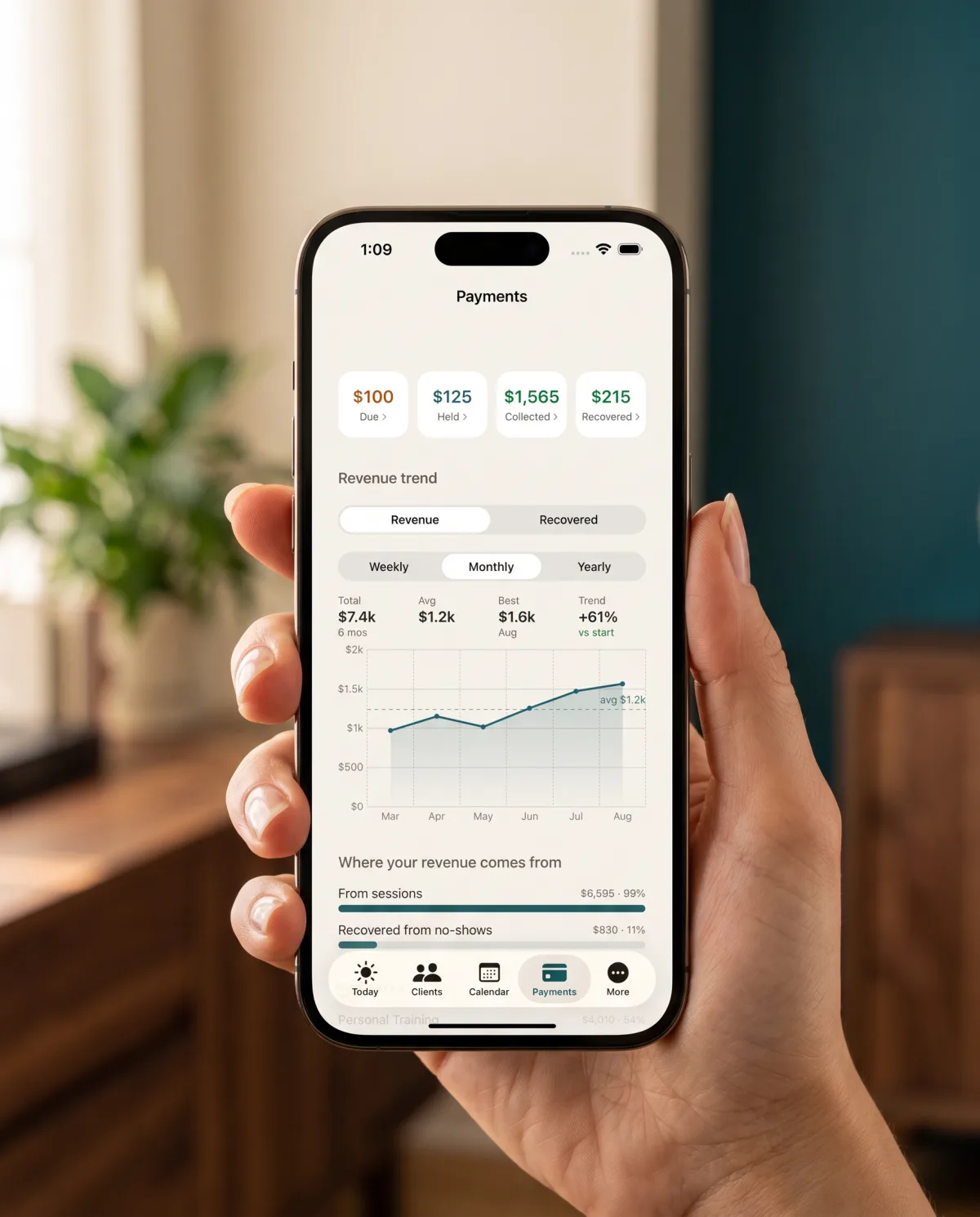
Our own app, photographed on a real phone. Demonstration data.
The whole product, through one booking
Take one appointment. Tuesday, 2:00 PM.
On most calendars that is a name and a time. Here is everything sitting behind it.
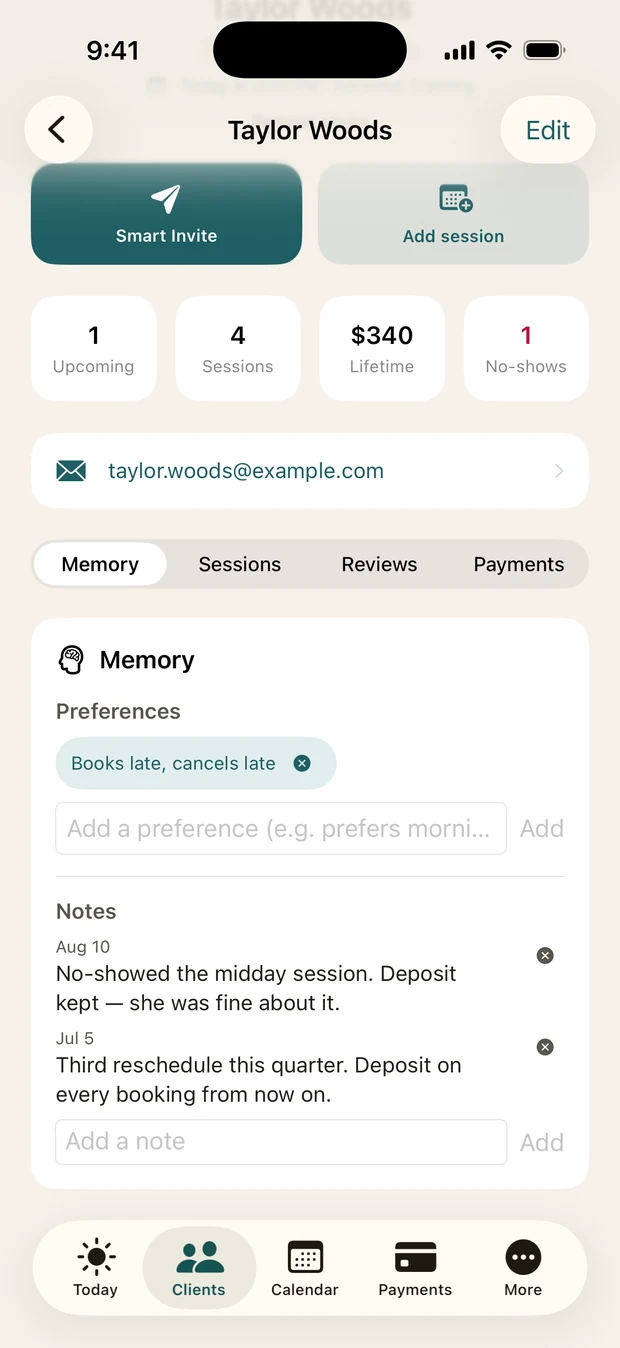
It remembers how each client actually behaves.
Four visits, $340 spent, one missed, and a habit of booking late. None of that is something you have to hold in your head between appointments, and none of it was typed in for this page.
You write that rule once, on the client or on the service. Nothing here was written for this page.
If she moves it
The open time is offered before you have put your tools down.
She cancels tomorrow’s 2:00 PM
From her phone, the evening before. She does not have to reach you, and you do not have to be reachable.
The slot goes to the people already waiting
Everyone on your waitlist for that service is offered it at once, with a link that books it. First to book gets it. Nobody is holding it for anybody.
You find out afterwards
You were with a client while all of it happened. That is the part you are paying for.
What you see afterwardsWe notified 3 waitlist clients. First to book gets it.
Automatic freed-slot recovery is a Pro capability. On Starter the waitlist is yours to offer by hand.
The business you are actually in
A calendar slot is perishable. An unused one expires at 2:30 PM and cannot be sold at 2:31 PM.
That is the whole reason a no-show is not an inconvenience.
The money goes round. That is the point of a regular client.
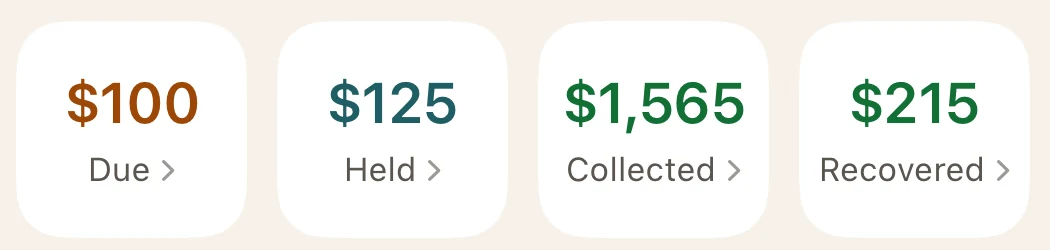
Due, Held, Collected, Recovered. One deposit moves through them and comes back, because the same client books again. Personal Training at $85 with a $25 deposit.
| Date | Client | Session | Deposit | What happened | Yours |
|---|---|---|---|---|---|
| Aug 18 | Morgan Lee | Personal Training | $25 | Booked, deposit not yet paid | Due $25 |
| Aug 16 | Dana Brooks | Personal Training | $25 | Not yet happened | Held $25 |
| Aug 15 | Sam Rivera | Personal Training | $25 | Cancelled four hours before | Recovered $75 |
| Aug 14 | Casey Nguyen | 1-on-1 Strength | $50 | Attended | Collected $140 |
| Aug 13 | Sam Rivera | 1-on-1 Strength | $50 | Did not arrive | Recovered $140 |
| Aug 12 | Dana Brooks | Personal Training | $25 | Attended | Collected $85 |
| Aug 9 | Morgan Lee | 1-on-1 Strength | $50 | Attended | Collected $140 |
| Five appointments happened. Nobody attended two of them. | $580 | ||||
Demonstration data. The two rows nobody attended come to $215: a $75 late cancel and a $140 no-show. That is the same $215 the Payments screen above reports as Recovered. Two places, one number, and neither was built for this page.
Held is the one people misread. It is not a pending authorisation waiting to be approved: the deposit is paid, it is sitting in your Stripe balance, and it comes off what they owe on the day. Nobody has to be chased for it and nothing has to be re-attempted.
Recovered is the one worth being precise about. It does not mean something decided on its own that a client deserved to pay. Each of those two rows is a moment where you looked at what happened and said yes. Sessurely does not charge a client without asking you, on any plan. That is a deliberate limit rather than a missing feature: a tool that bills your clients on your behalf is a tool you switch off the first time it gets one wrong.
Where a deposit actually goes
Your client pays the deposit you set
$25 on an $85 session, at the moment they book. Nothing is added on top, so the figure on their card statement is the figure you asked for.
Stripe moves it into an account in your name
You verified that account with Stripe directly, not with us. We never see a card number. Stripe takes $1.03 for processing the card, and our 2% comes off your side as a $0.50 application fee, capped at $10.
It lands in your balance and pays out to your bank
$23.47 of the $25, on your own payout schedule, held by Stripe under your name until then. Which means there is no point in the journey where the money is ours. Sessurely never holds your money.
| Your client is charged | $25.00 |
|---|---|
| Stripe, 2.9% plus 30 cents | −$1.03 |
| Sessurely, 2% capped at $10 | −$0.50 |
| Lands in your balance | $23.47 |
The fee is taken when the deposit is taken, whatever happens at the appointment afterwards. If the client attends, we do not take a second percentage from the rest of what they pay. Stripe’s rate is not ours: the figures here are their standard United States online card rate, and international cards and currency conversion are priced differently. Check any of this against your Stripe dashboard and it will match to the cent.
When she pays the rest
The card reader is the phone already in your hand.
The session is over and there is $60 left on that $85 appointment. She taps her card, her phone or her watch against yours, and it is done before she has found her coat. Nothing to buy, nothing to charge overnight, nothing to carry between clients.
It is the same journey the deposit took, with one difference. Stripe still processes the card, and it still lands in the account in your name. We take nothing at all on what you collect in person.
Tap to Pay on iPhone is a Pro capability, available in the United States on iPhone XS and later.
Afterwards
The follow-up is written and waiting for you.
Drafted from what actually happened at the appointment, ready to read and send. Never sent on your behalf, because a message from you should have been read by you first.
And what you learned about her today is on her record before you have finished tidying up, so the next time she books you are not starting from memory.
Follow-up drafting is a Pro capability.
Pricing
Starter gives you the tools. Pro does the work.
Starter is free, with no clock on it, and it never asks for a card. We would rather be paid when appointment protection actually produces money than charge you for a calendar.
So when it produces money, we take 2% of a deposit or a no-show fee, capped at $10.
Nothing on your session prices. Nothing on packages or gift cards. Nothing added to what your client pays.
Starter
Free, and it stays free
No card. No trial clock. It does not expire.
- Booking page, calendar and client book
- Intake forms and email reminders
- 100 texts a month to U.S. numbers
- A waitlist you offer by hand
- Kept, no-showed and show rate, as raw history
Pro
Free for 7 days$69.99/mo
Or $599.99 a year, an effective $49.99 a month.
Everything in Starter, and then Sessurely starts doing the work you are not there to do.
- Deposits and a card on file, so booked time is held
- No-show and late-cancel fees charged to that card
- A freed slot offered automatically, while you are working
- Reliability read for you, not just recorded
- Follow-ups drafted for you to approve, never sent for you
- Tap to Pay on iPhone, so the card is tapped on your phone, not a reader
- Packages, gift cards, and texts with no monthly allowance
To check that against your own prices rather than ours, the calculator shows the arithmetic with our fee already subtracted. For the full list of what sits in each plan, compare Starter and Pro.
The honest answers.
Will asking for a card scare clients off?
Nothing is hidden from them. Your policy is on the booking page before they choose a time, they agree to it as they book, and it is repeated in their confirmation. If you take a deposit it is charged then and comes off what they owe on the day, so they are never asked for the same money twice. If you hold a card instead, it is only used on a no-show or a late cancel, under the policy they already agreed to. You set the window and the amount, so it stays fair.
What's the difference between Starter and Pro?
Starter gives you the tools. Pro does the work you are not there to do. Starter is free forever and never asks for a card: your booking page, calendar, client book, intake forms, a waitlist you offer by hand, email reminders and 100 texts a month to U.S. numbers, plus your kept and no-showed history as raw numbers. Pro is what acts while you are with a client: a deposit and a card on file hold the booking, a no-show or late-cancel fee is charged to that card, a slot freed by a cancellation is offered to your waitlist automatically, reliability is read rather than only recorded, and follow-ups are drafted for you to approve. Free for your first 7 days, then $69.99 a month, and never a commission on your sessions.
How do you actually charge a no-show?
The client adds a card when they book and agrees to your policy. If they do not turn up, you mark them as a no-show, and the fee you set is charged to that card. Late cancellations inside the window you set work the same way. It runs through Stripe, to the card they already agreed to. You do not send an invoice, and you do not have to decide in the moment whether you are the kind of person who charges for this. That decision was made once, in your service settings, on a calm afternoon.
Are there per-booking or hidden fees?
You pay one flat monthly price. No per-booking charge and no commission on your session prices. The only additional fee is a small 2% no-show-protection fee, capped at $10, on the deposits, no-show fees and late-cancellation fees we process for you. Nothing on what you take in person with Tap to Pay on iPhone. Stripe's standard card processing applies to charges, like it does everywhere.
How the charge actually works, in full, including disputes, switching from another scheduler and what your clients see.
You have read the whole thing
That was one appointment. You have thirty a week.
It is 4 missed appointments a month at $120, and it will be there again next year unless something charges the person who missed. Starter is free forever, so finding out costs you nothing.
Missed appointments, twelve months
$5,760
$120 × 4 a month × 12. Your figures, our multiplication.
This is what missed time costs you, not what Pro returns. Move the sliders to your own numbers.
The part nobody puts a number on: never writing the awkward message. Never carrying a client in your head between visits. Closing the door at six with nothing left waiting for you.

Reading this on a laptop?
Hold your phone camera up to the code and set it up where you will actually use it. Widgets and Apple Watch come with it.